Wednesday, June 8, 2011

Day 2 of Service---Tuesday, June 7

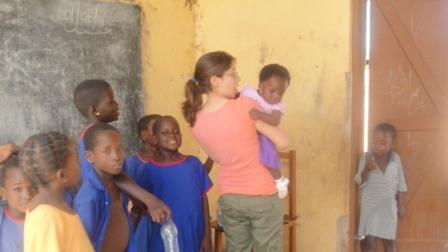
Today marks day two of us teaching in the local schools. We each ventured off to our respective locations for a morning full of learning. Each of us have been assigned different tasks, ranging from helping to build an addition for the Maltiti school to teaching basic reading and writing skills.

Even though it is only the second day, we can already feel a connection with each one of our students. They are eager to learn but, there is an inevitable language barrier that can sometimes hold up the learning process. We are however, greatly appreciated due to the lack of teachers in the schools. Some schools can have only one teacher teaching multiple levels, while others have none at all.

We are embracing the Ghanaian culture through some classes of our own. Today we learned about the many different ethnic groups that are present throughout Ghana's 10 regions. We had a conversation with a couple of locals about how the gender roles influence peoples daily lives. Unlike in American culture, women here are in a subservient role within society. For example, women not only must cook for the husband, but she also must serve him his food properly with a bow. It is our hope that by trying to educate the young girls that are growing up in these households we can help them not to follow in the footsteps of their elders.

We ended our day with our second dance and drumming lesson. We are each trying our best to perfect our skills before our big performance on Friday. We will try hard not to disappoint!


Day 1 of Service Learning (Monday, June 6)

"Tamale students, in a variety of grades and schools, demonstrates a passion to learn and dedication to improve in their classroom subjects”

Today was our first day immersed in the Tamale classrooms, excluding the men who sweat through the first steps of building an administrative and volunteer office at the Matiti Junior School. The Women of the group provided the students with lessons on reading and English comprehension. The Ghanaian students showed much determination, although some struggled with word pronunciation and understanding general terms that we often take for granted. We found repetition and applying words in a different context as key tools during the lesson. Similar to U.S. Schools that lack in resources, it is very difficult to provide individual attention to students who need aid or to those who are excelling. This is due to the large classroom size. Teachers become overwhelmed with discipline and trying to teach the basics therefore a new model or way to educate needs to be examined in rural Ghana. Programs such as staying after school for extra help do not exist amongst the villages where students also have a full job and a priority for helping their family. With every struggle shown from the students, two times more effort was put into trying to ensure that they understood the materials that we were teaching.

After our volunteer experience in the village, we visited a local small business that made leather products. We learned that production of leather could take more than a week for one finished product that only cost seven American dollars or 10 Cedis. The labor involved with creating leather is a long process. Each step is crucial in order to create the completed product, which can be made into belts, shoes, wallets, etc. This process is an example of the level of effort and work that goes into working in one of the many Ghanaian industries, where caring for your home, farming, selling goods at the market or just simply cooking much time and effort is devoted to that particular service. Hard work has been second nature for many Ghanaians and the beauty of it all is their joy at the end of the day.

Admittedly, this happiness aura in Ghana cannot match those whom indulge in materialistic items. We have surrounded ourselves in this aura to finish our day with our first dance and drum lessons. Although sweat was a prime ingredient during this time, we all enjoyed our beginning steps of knowing the Ghanaian soulful music. Our repetitious steps and drumming brought the children from the streets to our location. Our successful (or not) routine will be presented in front of a village of many on Friday. To sum up the day….. it’s been fantastic!


Monday, June 6, 2011

Sundays in Tamale

This blog was written by Amanda and Colleen

Sundays in Ghana are very relaxing for everyone. The past few days we learned about Ghanaian time, which means that 10 am is really 11 am. That is when we got picked up to go to the Methodist Church. The service was longer than what we are used to at home. The differences were seen in everything from the collection baskets to the homily.

Later in the afternoon we went to a public pool to cool off. The pool was fun and we taught some locals how to swim. We met up with the dancers and musicians from the village ceremony from the previus night. It was great to hangout with some local friends. The downtime that we had today gave us a great opportunity to talk with Ghanaians. It was a much appreciated Sunday in Tamale.

Women Labor and Tradtional Culture

Today's blog is written by Ryan and Cinnamon!


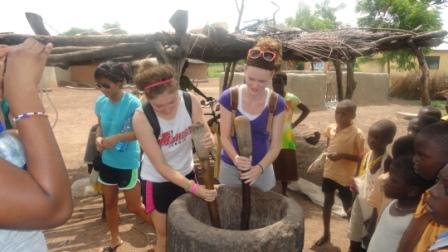
On June 4, we started out the day by travelling to a nearby village and getting a closer look at the daily lives of women in the community. We were immediately able to tell that their days were quite busy. The first activity Fredrick showed us was the processing of Shea butter. The women sat in the shade, and for hours, beat the unprocessed Shea until it turned into a light tan color. I (Cinnamon) gave this a try, but it only took about five minutes before her arms were burning. To think that these women sit under a tree literally all day and do this is incredible. Throughout the rest of the tour, we witnessed other female duties such as the cultivation of rice, the grinding of various spices and herbs such as cassava, cooking, taking care of the children, and more.

Although it seems like the women have it rough, the men have to deal with the majority of the work. They have to play football, rest, chop some wood, rest, play board games, rest, stay in the shade, and help populate the village. It was mind blowing to see the enormously unbalanced responsibility placed upon the women as opposed to the “heads of the family.”

Later that evening, the entire group was invited to take part in a traditional dance celebration. Surprisingly, the men did most of the dancing and drumming. It seems to be the only responsibility that the women do not have. Regardless, the celebration was very exciting, and we were able to embarrass ourselves sufficiently. Making them laugh was the least we could do in return for such a generous gesture.

After the traditional performance, we went to a new sports stadium and witnessed a modern Ghanaian Rap/R&B concert. It was shocking to see such a sudden switch from village culture to a somewhat Western production. Most people were dressed in American fashion and acted like typical American teenagers. It’s incredible to think that modern culture can exist so close to the ancient, tribal cultures of the past.

Saturday, June 4, 2011

Day 2 in Tamale-Culture Culture Culture

Today we welcomed our first full day in Tamale. We are slowly but surely adjusting to our new enviroment in Northern Ghana where temperatures soar into the nineties with an overwhelming humidity.

We started our day by eatting a traditional Ghanaian breakfast consisting of a sweet bread, eggs, jam and tea, which was prepared by one of our neighbors. Fueled for the day, we set off to the Maltiti School for girls where we split up and taught in each of the four classrooms. Although we come from various cultures, we were able to teach one another some traditional songs. We were also given the opportunity to visit some of the other local schools, including a school where we will spend the reminder of our trip teaching at.

After our visits to the various schools, we visited several villages where we were introduced to the main chiefs. Following the traditional Ghanaian custom, we removed our shoes at the door, sat on cow hides and communicated with the chief via our host Frederic. Although it is customary not to speak directly to the chief, we definitely felt a great sense of welcoming.

We then took a tour of a couple villages, where we witnessed some of the daily routines of village life. Everyone welcomed us into their homes and showed us their living arrangments with open arms. It was interesting to learn that men and women do not live together, even if they are married. You can tell the difference in residence simply by the shape of a home. Men live in rectangular huts, whereas the women's living quarters are circular in shape.

Later in the evening, we were taken to the school where this time, it was our chance to learn the native language, Dagbani. We all caught on pretty quickly and have been trying to incorporate the dialect into our conversations with the native people. One phrase we learned was "Aningwula" which means good evening.

Following a long day, we ended our evening with a lovely homecooked meal prepared by a couple of the local girls. We can't wait for another exciting adventure tomorrow!!!


Travel day to Tamale

Today, Thursday, June 2nd was a travel day for the group. We embarked on a plane ride from Accra to Tamale, which is located in the northern region of Ghana. Tamale is known to many as the NGO Capitol. It is home to many national, international, and local Non-Governmental Organizations (NGOs) or otherwise known as nonprofit organizations. These organizations are working on a variety of community and economic development projects ranging from educating rural villages, to programs that foster economic empowerment for women. Tamale has become the NGO Capitol because of the extreme poverty that exists within the northern region of Ghana. In Tamale and other northern cities, the way of life has not modernized like the southern part of Ghana. In the north, families are still living very traditional where families have to fetch their own water down at the river, honor thy chief; the men farms and the women and children sell goods in order to feed the family. The pinnacle of the traditional way of life is to live modestly, happily and with thy family.

When we arrived in Tamale, we immediately visited the chief of the village that we were going to staying in. We had to pay respect to him and get his blessing. While the traditional way of life is new to us, we appreciated the preservation of one’s culture. With modernity often comes change and that lost of thyself and they people.


Day 2 in the Cape Coast

It is incredible to think that this has only been our sixth day in Ghana. Our group has grown so much in the last week. Although some of us have traveled before, few of us have seen any part of the world that is this under-developed. From the general lack of sanitation to the extreme poverty, to say that we are experiencing ‘culture shock’ would be an understatement. Considering the fact that our comfort zone ranges from long Island to Poughkeepsie, our quick assimilation to Ghanaian standards is very impressive.

We began the day with a trip to a school that happened to be right next to the hotel in which we stayed (Prospect Lodge, Cape Coast). Since it had been raining early that morning the teachers casually decided not to show up. The children had not been informed of this and they were wondering around the school unsupervised. Thus, we substituted ourselves as teachers and provided an on the spot lesson to children of different ages. The students turned out to be very interested in subjects like science, psychology, and math. They were also quite curious about the United States. From President Obama, to basketball, to various festivals, the kids were eager to learn more about this country and understand what their parents had told them about it.

The rest of the day was used to take a trip to Kakum National Park and a Crocodile Farm. The Canopy walkway at Kakum National Park is the longest calculated walkway in Africa. Upon completion, we became a part of the select group of people who could say that they have walked the longest elevated walkway of both Africa and the U.S. (walkway of the Hudson).

At night we walked around the town of Cape Coast. As usual, the people were friendly and polite. Everyone wanted to talk to the Americans. To me (Ryan), this reinforced the utopic image Ghanaians appear to have of the U.S. It’s unfortunate that Ghanaians such as our tour guide, Nikoi, are having trouble getting into the U.S. Our culture could learn a lot from each other.


Wednesday, June 1, 2011

Cape Coast and the Slave Castles

After departing from Accra, we arrived in the Cape Coast to explore a new part of Ghana! Upon settling into our new residence, we travelled to the slave castles that were used in the Transatlantic Slave Trade. Our first stop of the day was to the Elmina Castle, where we toured the grounds that once held thousands of slaves against their will. It was interesting to learn that the castle was initially built for the gold trade but was then used as a holding place for the slaves before they made the long journey overseas.

As we continued our tour of the castle, we were guided through the many male and female holding cells which held up to one hundred people at one time. We learned that for up to three months, the captives had to eat, sleep, and go to the bathroom all while being chained together in groups of five. We were also introduced to some local residents of the castle, a cave full of friendly bats who even posed for some pictures!!

Next on the agenda was Cape Coast Castle, which unlike Elmina was built specifically for the slave trade. Slaves experienced worse conditions at the Cape Coast Castle, as they were held underground with little light or ventilation. Captives were held hundreds at a time where they were again forced to eat, sleep and go to the bathroom all in the same area. Our guide explained how women were treated much worse compared to the male slaves and how they were often raped and abused by the soldiers.

It was definitely unsettling to step foot in these slave castles, yet it was an important part of our trip to learn more about this period in Africa's history. After reflecting on the things we saw throughout the day, we were happy to stumble upon people taking part in traditional African dancing. We observed them rehearsing for an up-coming tour that will give them the opportunity to perform in Philadelphia in the future. It was an amazing sight to see, and it made us feel right at home with the Ghanaian people.